
The traditional image of a business student—someone focused solely on networking, leadership theories, and marketing presentations—has undergone a radical transformation. In the current global economy, the boardrooms of London, New York, and Tokyo are no longer governed by intuition alone. Instead, they are driven by data, algorithms, and complex models. For undergraduates entering the field today, the realization that a business degree is increasingly a “math-heavy” endeavor can be a significant culture shock. However, this shift is not a barrier; it is a response to a world where “gut feeling” has been replaced by “data-driven certainty.”
The transition from general education to specialized university modules is often where students feel the most pressure. The sheer volume of technical reports and case studies can be overwhelming, leading many to seek external support to maintain their academic standing. In this high-stakes environment, it is common for individuals to look for reliable resources to do my assignment for me as a way to navigate the heavy workload and ensure their submissions meet the rigorous standards expected by UK and international universities. Balancing these demands allows students to focus on deep learning rather than just surviving the next deadline.
The Rise of the Quantitative Business Model
The shift toward mathematical proficiency in business is largely due to the “Big Data” revolution. Every consumer click, supply chain movement, and stock market fluctuation is recorded. To make sense of this, businesses require professionals who can perform more than just basic arithmetic.
- Predictive Analytics: Companies now use historical data to predict future trends. This requires a firm grasp of statistics and probability.
- Algorithm Development: Whether it is pricing a flight or recommending a product, algorithms are doing the heavy lifting.
- Financial Engineering: Modern finance involves high-frequency trading and risk management models that are rooted in advanced calculus.
Why Logic and Numbers Outperform Intuition
In the past, a charismatic manager might have made decisions based on years of experience. Today, that experience is quantified. For an undergraduate, learning how to build a linear regression model is just as important as learning how to manage a team. This is because numbers provide a “neutral” ground for decision-making. When a student can prove a point using a statistical p-value rather than a subjective opinion, their authority in a professional setting increases significantly.
Essential Mathematical Domains in Modern Business
| Mathematical Domain | Application in Business | Importance Level |
| Statistics & Probability | Market research, consumer behavior, and A/B testing. | Critical |
| Calculus | Optimization of production costs and maximizing profit margins. | High |
| Linear Algebra | Data organization, search engine optimization, and neural networks. | Medium-High |
| Discrete Math | Logic gates for business software and supply chain logistics. | Medium |
Navigating the “Math Barrier” in Assignments
For many students, the “Mathematics” component of a Business or Economics degree is the most challenging hurdle. It is one thing to understand a business concept like “Supply and Demand,” but it is another entirely to calculate the equilibrium point using multi-variable calculus. This is where precision becomes the difference between a passing grade and an honors-level mark.
When the complexity of theorems and formulas becomes a bottleneck, many top-performing students turn to specialized academic assistance. For instance, obtaining expert Math Assignment Help from a dedicated service by MyAssignmentHelp can provide the clarity needed to solve abstract problems. This type of support doesn’t just provide answers; it offers a step-by-step breakdown of how a mathematical model applies to a real-world business scenario, which is essential for long-term retention.
The Global Tone: Adapting to International Standards
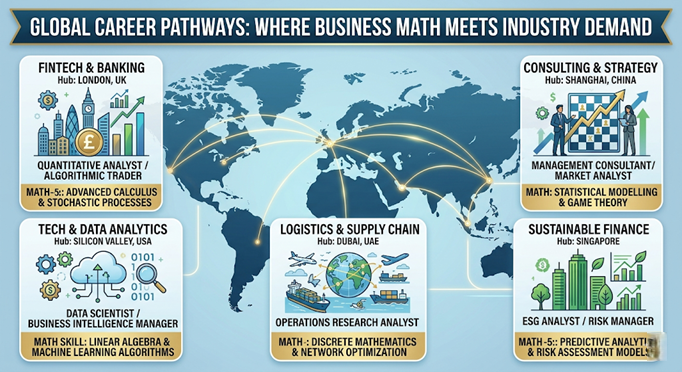
Business is a global language, and so is mathematics. Whether you are studying in Manchester, Sydney, or Dubai, the formulas for Net Present Value (NPV) or Internal Rate of Return (IRR) remain the same. Undergraduates must adopt a global mindset, understanding that their ability to interpret data makes them employable in any country. A student who can navigate a spreadsheet and run a statistical analysis is a “universal” asset in the job market.
Bridging the Gap Between Theory and Practice
The ultimate goal of a business degree is to prepare you for the “Real World.” In a corporate setting, you won’t be asked to solve a math problem in a vacuum. You will be asked to solve a business problem using math as your tool.
- Marketing: How do we calculate the “Customer Lifetime Value”? (Requires Algebra and Stats).
- Logistics: How do we find the shortest delivery route for 1,000 trucks? (Requires Graph Theory).
- Human Resources: How do we measure employee retention probability? (Requires Predictive Modeling).
By viewing mathematics not as a separate subject, but as a “Business Tool,” students can reduce the anxiety associated with the subject and start seeing the patterns that lead to success.
Conclusion: Embracing the Future
The integration of advanced mathematics into business degrees is a reflection of our technologically advanced society. While it may seem daunting at first, mastering these skills provides a competitive edge that cannot be ignored. By utilizing available resources—ranging from peer study groups to professional academic services—students can overcome the technical challenges of their degree and emerge as leaders who are both strategically minded and numerically proficient.
Frequently Asked Questions (FAQ)
Q.1. Why is math so important in a non-STEM degree like Business?
Ans: Modern business relies on data to minimize risk. Mathematics provides the tools to analyze that data, making it essential for any role involving finance, marketing, or operations.
Q.2. I am not a “math person.” Can I still succeed in a Business degree?
Ans: Yes. Mathematical proficiency is a skill that can be learned. With the right resources, such as university tutoring or specialized assignment help, any student can master the necessary concepts.
Q.3. What specific software should I learn to help with my math assignments?
Ans: Excel is the industry standard. However, learning R, Python (for data analysis), or SPSS can significantly improve your ability to handle complex mathematical assignments.
Q.4. How does mathematics improve my employability?
Ans: Employers look for “Quantitative Literacy.” Being able to show that you can handle budgets, analyze market trends, and interpret statistical reports makes you a much more attractive candidate.
Q.5. Is it common for students to seek help with mathematical modules?Ans: Absolutely. Because math is a “cumulative” subject (where one concept builds on the next), many students seek external guidance to ensure they don’t fall behind in the early stages of their degree.