Gardening advice travels strangely. A tip passed down from a grandparent, a rule of thumb repeated often enough to feel like fact, a technique that someone saw work once and has since elevated to gospel. The internet has accelerated this considerably, surrounding genuinely useful guidance with a thick sediment of received wisdom that ranges from mildly unhelpful to actively counterproductive.
Some of it is harmless. Some of it costs money. Some of it kills plants. Here are eight of the most persistent garden myths, and what actually happens when you examine them honestly.
Myth 1: You need a big garden to make it worth bothering
The truth: Some of the most productive and beautiful gardens in the country are tiny.
This one stops people before they even start. The assumption that serious gardening requires serious space has no basis in reality, and yet it persists with remarkable stubbornness. The truth is that small gardens, courtyards, balconies, and even large windowsills are all capable of supporting genuinely rewarding growing — they just require a different approach to a large garden, not less effort or less ambition.
Container growing has become sophisticated enough that almost anything can be grown without a border. Trained fruit trees in pots, productive raised beds on patios, climbers that go upward rather than outward: the small garden rewards creativity in a way the large one sometimes doesn’t, because every decision matters more and every successful plant earns its place.
The gardeners consistently getting the most from limited space tend to be more knowledgeable, more intentional, and frankly more skilled than those with a limitless lawn. Small is not a disadvantage. It is a different kind of challenge, and often a more interesting one.
Myth 2: You should add grit to clay soil to improve drainage
The truth: Unless you add an enormous amount of grit, you will make the problem worse, not better.
This is one of the most widely repeated pieces of gardening advice and one of the most reliably counterproductive. The idea sounds logical: clay drains poorly, grit drains well, therefore mixing them together should improve things. In practice, the opposite is usually true.
Adding a small or moderate amount of grit to clay creates something that behaves less like improved clay and more like concrete. The fine clay particles fill the spaces between the coarse grit particles, reducing the drainage still further. To genuinely alter the structure of clay soil using grit alone, you would need to add it in such quantities — roughly 50% by volume — that it becomes economically and practically absurd.
The effective treatments for clay soil are organic matter worked in generously and repeatedly over several seasons, raised beds that bypass the problem entirely, and plant selection that actually suits the conditions. Many excellent garden plants — Astilbe, Persicaria, Cornus, many roses — thrive in clay. Working with the soil you have, rather than trying to transform it, is almost always the more productive approach.
Myth 3: Watering plants in sunshine scorches the leaves
The truth: There is no credible scientific evidence that this happens under normal conditions.
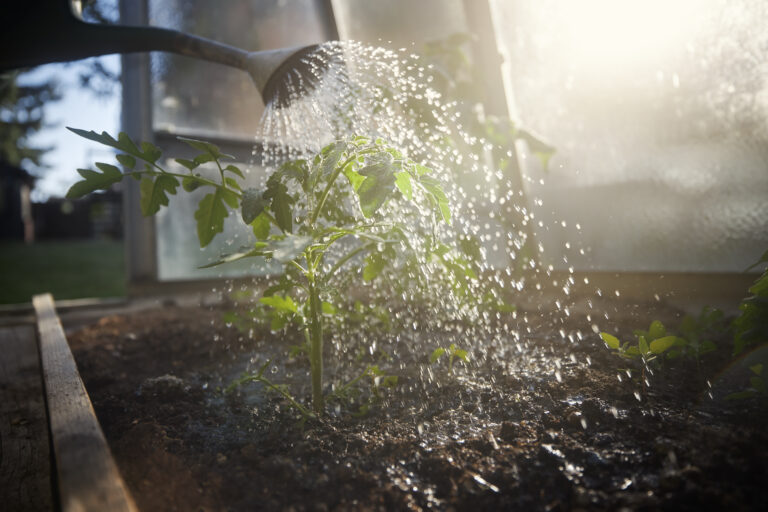
The idea that water droplets act as tiny lenses, focusing sunlight onto leaf tissue and burning it, is intuitively appealing and experimentally unsupported. Researchers who have specifically investigated this — exposing plants to overhead watering in direct sunshine — have been unable to reliably reproduce the scorch damage the myth predicts.
What is true is that watering in the heat of the day is less efficient than watering in the morning or evening, because more water evaporates before it reaches the root zone. Early morning watering is genuinely preferable, but for reasons of efficiency rather than fear of leaf damage. If your plants need water on a hot afternoon, water them. The risk of drought stress is real; the risk of scorch from wet leaves in sunshine is not.
Myth 4: A shed is just somewhere to keep the lawnmower
The truth: A well-chosen shed is one of the most versatile and genuinely useful structures you can add to a garden.
The shed-as-dumping-ground reputation is entirely self-fulfilling. Buy a shed that is too small, site it in a dark corner, and treat it as a last resort for things without a better home, and that is exactly what you will get. Buy a shed with some genuine thought — the right size, a sensible position, decent construction — and the thing it becomes is something else entirely. A potting station. A workshop. Somewhere to actually spend time. Dobbies’ garden sheds range is worth browsing if you’re reconsidering what a shed could be rather than simply replacing what you already have — the difference in quality and variety between a thoughtfully chosen shed and a default purchase is considerable.
The shed used as a garden office has become a genuine phenomenon for good reason: the physical separation from the house creates a psychological shift that a spare bedroom simply cannot replicate. The shed used as a potting shed, with a proper bench at working height, decent light, and shelving for seed trays and equipment, makes the whole business of propagating and growing significantly more pleasurable. None of this requires a large budget. It requires a slightly larger imagination than the lawnmower narrative allows.
Myth 5: You need to deadhead everything to keep it flowering
The truth: Some plants flower better for deadheading. Many are indifferent to it. Some are actively harmed by it.
Deadheading — removing spent flowerheads — does prolong the flowering season on a useful range of plants. Roses, sweet peas, dahlias, antirrhinums, and most annual bedding respond well because removing the seed head prevents the plant from directing its energy into seed production and encourages it to produce more flowers instead. For these plants, regular deadheading is genuinely worthwhile.
But applying this logic universally, as many gardeners do, misses the point significantly. Plants like Echinacea, Rudbeckia, Agastache, ornamental grasses, and most seed-bearing perennials produce seedheads that are architecturally beautiful, provide food for birds through autumn and winter, and create the overwintering habitat that beneficial insects depend on. Cutting them off in the name of tidiness removes these benefits entirely and produces a garden that looks bare and finished rather than alive and layered.
The question to ask before deadheading is not whether it looks untidy, but whether the spent flower has something better to offer than another flower. Often it does.
Myth 6: Organic gardening means lower yields and more effort
The truth: In a home garden context, organic growing frequently produces better results with less intervention, not more.
The yield argument against organic growing is drawn largely from commercial agriculture, where the economics of scale and the pressure for uniformity create genuinely different constraints to those faced by a home gardener. In a domestic garden, the comparison rarely holds.
A well-managed organic kitchen garden — fed with good compost, mulched generously, planted to encourage beneficial insects — tends to need less intervention than one maintained with chemical inputs, not more. This is partly because healthy soil produces genuinely stronger, more resilient plants. It is partly because encouraging natural predators — ladybirds, hoverflies, ground beetles, hedgehogs — creates a balance that manages pest pressure without the gardener’s involvement. And it is partly because organic growing demands attention to the fundamentals of soil health and plant selection in ways that chemical gardening can paper over for a season or two before the problems compound.
The first year of transitioning to organic methods is sometimes difficult. The subsequent years are usually not.
Myth 7: Native plants are always better for wildlife than non-native ones
The truth: Origin matters less than structure, pollen accessibility, and flowering time.
The native-plants-only argument is well intentioned and contains a genuine core of truth: many native plants have evolved alongside native insects and provide food and habitat in specific, irreplaceable ways. Ancient hedgerows of native species support biodiversity that ornamental planting cannot match. This is real and important.
But the strict interpretation — that non-native plants are worthless or actively harmful for wildlife — is not supported by the evidence. Studies from the RHS and others have consistently found that what matters most to pollinators is the accessibility of pollen and nectar, the length of the flowering period, and the structural diversity of planting. Many non-native plants score extremely highly on all these measures. Verbena bonariensis, Agastache, single-flowered Dahlias, Echinacea, and Nepeta are all non-native species that support high levels of pollinator activity. A garden of densely packed native plants with little structural variety may support less wildlife than a thoughtful mix of native and non-native species.
The more useful principle is to avoid highly-bred cultivars with modified flowers that have reduced pollen, choose single over double flowers wherever possible, and aim for something flowering from February to November. Where you source your plants is considerably less important than how you choose them.
Myth 8: If a plant dies, you have failed
The truth: Plants die. This is not failure. It is gardening.
The assumption that a skilled gardener is one whose plants never die is both widespread and entirely wrong. Every experienced gardener has killed things — often the same thing, several times, before understanding why. The gardener who claims otherwise is either very boring in their plant choices or not paying close enough attention.
Plants die because conditions change. Because a winter is harder than expected. Because the drainage was not quite right. Because something was planted slightly too deep, or too shallow, or at the wrong time of year. Because the thing that looked fine in the pot turned out to want conditions that this particular garden cannot provide. All of these are useful pieces of information, not verdicts on your competence.
The gardeners who develop genuine skill and knowledge are almost always the ones who have killed the most things and paid attention to why. Treat every dead plant as data rather than defeat, and you will learn faster than any amount of reading will teach you.
Gardens are not static, and they are not controllable, and they are not won or lost. They are ongoing, imperfect, perpetually instructive projects. The myths listed above share a common feature: they make gardening feel more prescriptive, more fragile, and more likely to go wrong than it actually is. Discard them, and the whole enterprise becomes considerably more enjoyable.