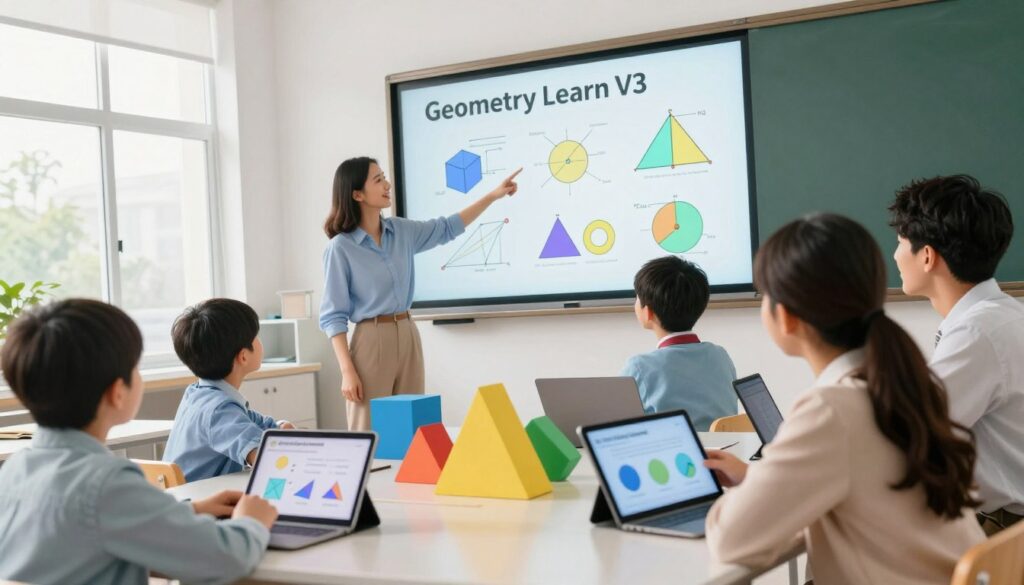
Have you ever looked at a geometric diagram and wondered why some people seem to understand it instantly while others stare at it for minutes without knowing where to begin? Geometry has always been one of those subjects that can feel either fascinating or frustrating, depending on how it is taught.
For many learners, traditional methods often focus heavily on memorization. Formulas, theorems, and definitions pile up quickly, making geometry seem more complicated than it really is. That’s where Geometry learn v3 enters the picture. Designed to make geometric concepts easier to understand, it offers a more interactive and structured learning experience that helps students connect ideas instead of simply memorizing them.
Whether you’re a student preparing for exams, a teacher looking for better resources, or simply someone interested in mathematics, understanding how Geometry learn v3 works can open the door to a much more enjoyable learning journey.
Understanding Geometry Learn V3
At its core, Geometry learn v3 is a learning approach or educational platform designed to help users understand geometric concepts through visualization, practice, and step-by-step instruction.
Instead of presenting geometry as a collection of disconnected rules, it focuses on building a strong foundation. Learners gradually develop an understanding of shapes, angles, measurements, proofs, and spatial reasoning through interactive lessons and guided exercises.
One of the biggest challenges in geometry is seeing relationships between different elements. A triangle isn’t just a triangle—it contains angles, side lengths, symmetry, and mathematical relationships. Geometry learn v3 helps users recognize these connections more naturally.
The result is a learning experience that feels less intimidating and much more practical.
How Geometry Learn V3 Works
Understanding the mechanics behind Geometry learn v3 can help learners maximize its potential.
Interactive Visual Learning
Geometry is a highly visual subject. Reading about shapes is useful, but actually seeing them transform and interact creates a deeper understanding.
Geometry learn v3 often emphasizes dynamic diagrams that allow learners to explore concepts visually. When shapes move, rotate, or change dimensions, students can instantly observe how mathematical properties respond.
This visual feedback makes abstract concepts easier to grasp.
Step-by-Step Problem Solving
Many students struggle because solutions in textbooks sometimes skip important reasoning steps.
Geometry learn v3 breaks complex problems into manageable parts. Instead of jumping directly to the answer, learners are guided through the logic behind each step.
This method develops confidence and encourages independent thinking.
Progressive Skill Development
Learning geometry effectively requires a gradual progression.
The platform typically introduces basic concepts first:
- Points and lines
- Angles
- Triangles
- Quadrilaterals
- Circles
- Polygons
- Coordinate geometry
As learners gain confidence, they move toward more advanced topics such as proofs, transformations, and geometric reasoning.
Immediate Feedback
One particularly useful feature of modern learning systems is instant feedback.
Instead of waiting for a teacher or tutor to review work, learners can immediately identify mistakes and understand why they occurred.
This rapid correction process accelerates learning significantly.

Key Concepts Covered in Geometry Learn V3
Geometry encompasses a wide range of mathematical ideas. Geometry learn v3 usually focuses on several fundamental areas.
Shapes and Their Properties
Understanding geometric shapes forms the foundation of the subject.
Students learn about:
- Triangles
- Squares
- Rectangles
- Circles
- Pentagons
- Hexagons
- Three-dimensional figures
Each shape possesses unique properties that influence calculations and problem-solving techniques.
Angles and Measurements
Angles appear everywhere, from architecture to engineering.
Geometry learn v3 teaches learners how to:
- Measure angles
- Identify angle types
- Understand complementary angles
- Work with supplementary angles
- Solve angle relationships
These skills are essential for more advanced geometric reasoning.
Area and Perimeter
Calculating area and perimeter is one of the most practical applications of geometry.
Students discover how to determine:
- Surface coverage
- Boundary lengths
- Composite figure measurements
- Real-world dimensions
These concepts appear frequently in both academic and professional settings.
Transformations
Transformations help learners understand how shapes behave under various operations.
These include:
- Translation
- Rotation
- Reflection
- Dilation
Exploring transformations improves spatial awareness and mathematical intuition.
Geometric Proofs
Proofs are often considered one of the most challenging aspects of geometry.
Geometry learn v3 simplifies the process by teaching logical reasoning step by step.
Instead of memorizing proof formats, learners focus on understanding why mathematical statements are true.
Benefits of Geometry Learn V3
The popularity of Geometry learn v3 is largely driven by its numerous educational advantages.
Improves Conceptual Understanding
Many students memorize formulas without truly understanding them.
Geometry learn v3 emphasizes comprehension over memorization, helping learners build stronger mathematical foundations.
Enhances Visual Thinking
Geometry naturally develops visualization skills.
By working with diagrams and interactive models, learners become better at interpreting spatial information and recognizing patterns.
Builds Problem-Solving Skills
Mathematics isn’t just about finding answers.
It’s about thinking critically, analyzing information, and applying logic. Geometry learn v3 encourages these valuable skills through structured challenges.
Increases Confidence
Confidence often grows when learning feels manageable.
Breaking concepts into smaller steps allows students to experience success more frequently, reducing frustration and anxiety.
Supports Independent Learning
Modern learners increasingly prefer flexible study options.
Geometry learn v3 enables students to learn at their own pace, revisit lessons, and practice whenever necessary.
Why Geometry Learn V3 Matters Today
The importance of geometry extends far beyond classroom walls.
Geometry influences numerous fields, including:
- Architecture
- Engineering
- Computer graphics
- Design
- Robotics
- Construction
- Navigation
Understanding geometric principles helps individuals solve real-world problems more effectively.
Additionally, modern educational environments increasingly emphasize conceptual learning rather than rote memorization. Geometry learn v3 aligns perfectly with this trend by encouraging exploration and critical thinking.
In many ways, it reflects how people naturally learn—through observation, experimentation, and practice.
Practical Uses, Examples, and Applications
One reason geometry remains relevant is its remarkable practicality.
Architecture and Construction
Every building relies on geometric principles.
Architects use geometry to design structures that are functional, stable, and visually appealing.
From floor plans to roof angles, geometry plays a central role.
Engineering
Engineers constantly apply geometric reasoning.
Whether designing bridges, vehicles, or machinery, understanding shapes and measurements is essential for success.
Computer Graphics
Modern video games and animations depend heavily on geometry.
Characters, environments, and visual effects are all built using geometric calculations and transformations.
Interior Design
Designers use geometry when arranging furniture, calculating dimensions, and optimizing spaces.
A strong understanding of spatial relationships leads to better design decisions.
Everyday Life
Even routine tasks involve geometry.
Examples include:
- Measuring rooms
- Planning renovations
- Creating artwork
- Reading maps
- Arranging objects efficiently
Geometry is often working behind the scenes, even when we don’t realize it.
Tips, Strategies, and Best Practices
To get the most from Geometry learn v3, consider these practical learning strategies.
Focus on Understanding First
Avoid rushing to memorize formulas.
Spend time understanding what each formula represents and why it works.
Meaningful learning lasts longer than memorization.
Draw Diagrams Frequently
A simple sketch can clarify a complex problem.
Even rough diagrams often reveal relationships that may not be obvious from text alone.
Practice Consistently
Geometry is a skill that improves through repetition.
Short daily practice sessions are generally more effective than occasional marathon study sessions.
Review Mistakes Carefully
Mistakes are valuable learning opportunities.
Instead of simply correcting an answer, analyze what caused the error and how to avoid it in the future.
Connect Concepts Together
Try to see how different topics relate.
Understanding how angles, triangles, transformations, and proofs interact creates a more complete picture of geometry.
Common Mistakes or Misconceptions
Even motivated learners can fall into certain traps.
Memorizing Without Understanding
Perhaps the most common mistake is relying solely on memorization.
Without understanding underlying principles, learners often struggle when faced with unfamiliar problems.
Ignoring Diagrams
Some students focus only on equations and overlook visual information.
Geometry is highly visual, and diagrams frequently contain critical clues.
Skipping Steps
Trying to solve problems too quickly often leads to mistakes.
Writing out each step improves accuracy and reinforces understanding.
Confusing Similar Concepts
Terms like perimeter, area, volume, and surface area are sometimes mixed up.
Taking time to distinguish these concepts prevents unnecessary errors.
Fear of Proofs
Many students assume proofs are impossible to master.
In reality, proofs become much easier when approached as logical conversations rather than intimidating formal exercises.
Interesting Facts and Insights About Geometry
Geometry has a fascinating history and continues to influence modern life in surprising ways.
- The word “geometry” comes from ancient Greek and means “earth measurement.”
- Ancient Egyptians used geometric principles when constructing pyramids.
- Geometry plays a major role in GPS navigation systems.
- Artists often use geometric patterns to create visual balance.
- Modern computer animation relies heavily on geometric calculations.
- Many natural structures, such as snowflakes, display geometric symmetry.
- Space exploration missions use geometry for navigation and trajectory planning.
These examples show that geometry is far more than a school subject—it is deeply woven into the world around us.
FAQs
What is Geometry learn v3?
Geometry learn v3 is a structured learning system or educational approach designed to help learners understand geometry through interactive lessons, visual demonstrations, and guided problem-solving techniques.
Is Geometry learn v3 suitable for beginners?
Yes. Geometry learn v3 typically introduces concepts gradually, making it accessible for beginners while still providing enough depth for advanced learners.
How does Geometry learn v3 improve understanding?
It focuses on visualization, step-by-step explanations, and immediate feedback, helping learners build genuine conceptual understanding rather than relying solely on memorization.
Can Geometry learn v3 help with exam preparation?
Absolutely. By strengthening foundational knowledge and improving problem-solving skills, it can be a valuable tool for preparing for geometry exams and assessments.
Why is geometry important in everyday life?
Geometry helps people understand space, measurements, design, construction, navigation, and countless real-world situations that involve shapes and dimensions.
Conclusion
Geometry has always been one of the most powerful branches of mathematics because it helps us understand the world visually and logically at the same time. Yet for many learners, traditional teaching methods can make the subject feel harder than it needs to be.
Geometry learn v3 offers a more engaging and learner-friendly approach. By combining visualization, structured lessons, practical applications, and interactive problem-solving, it transforms geometry from a collection of formulas into a meaningful system of ideas.
Whether you’re just beginning your mathematical journey or looking to strengthen existing skills, Geometry learn v3 provides an effective path toward deeper understanding. The more you explore geometric concepts, the more you’ll notice them everywhere—from architecture and technology to nature and everyday life. And perhaps that’s what makes geometry so fascinating: once you start seeing it, you can’t stop seeing it.