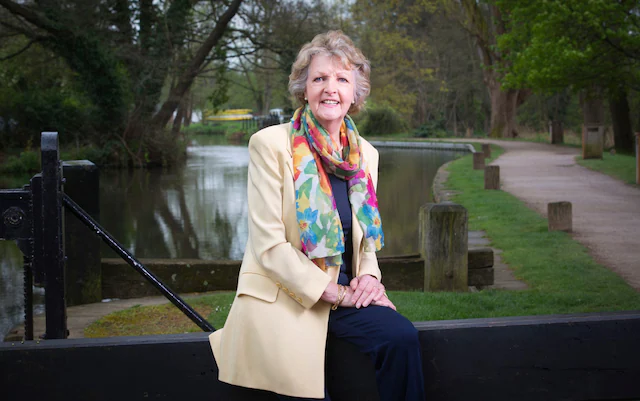
For decades, Penelope Keith represented a distinctive style of British acting—elegant, witty, and effortlessly memorable. While many television stars become closely associated with a single role, Keith built a career that stretched across theatre, television, radio, and documentary presenting. Her performances combined impeccable comic timing with a commanding stage presence, making her one of Britain’s most recognizable performers.
Audiences around the world continue to discover her work through classic sitcoms such as The Good Life and To the Manor Born, while theatre enthusiasts remember her equally accomplished stage career. Looking at her journey reveals not only the story of an outstanding actress but also how British television comedy evolved over several decades.
Early life and the path to acting
Penelope Anne Constance Hatfield was born on 2 April 1940 in Sutton, Surrey, England. Her childhood included time at boarding school before she eventually decided that acting was the career she wanted to pursue.
The path was not entirely straightforward. She was reportedly rejected by one drama school because she was considered too tall—a detail she later spoke about with characteristic humor. Instead of giving up, she trained at the Webber Douglas Academy of Dramatic Art, where she developed the classical skills that would shape her future career.
Those early years were spent in repertory theatre, performing a wide variety of productions around Britain. Like many respected British actors of her generation, this period provided invaluable experience, allowing her to tackle everything from comedy to Shakespeare before becoming widely known on television.
Penelope Keith and the stage before television fame
Long before she became a household name, Penelope Keith was earning admiration within the theatre world.
Joining the Royal Shakespeare Company in the early 1960s marked an important milestone. Working alongside experienced performers exposed her to demanding productions and helped refine the confident style audiences would later recognize on television.
Her stage career remained important even after television success arrived. Rather than abandoning theatre, she regularly returned to it throughout her career.
One of her biggest theatrical achievements came in 1976, when she received the Laurence Olivier Award for Best Comedy Performance for Michael Frayn’s Donkeys’ Years. Winning one of Britain’s highest theatre honors demonstrated that her talents extended well beyond sitcom acting.
The television role that changed everything
Many viewers first encountered Penelope Keith as Margo Leadbetter in The Good Life.
The sitcom, first broadcast in 1975, centered on suburban neighbors whose lifestyles could not have been more different. While Tom and Barbara Good embraced self-sufficiency, Margo and Jerry Leadbetter represented traditional middle-class aspirations.
Margo could easily have become an unlikeable caricature. Instead, Keith’s performance brought warmth beneath the character’s formality.
She portrayed Margo with remarkable precision:
- Confident without becoming unbelievable
- Proud yet surprisingly vulnerable
- Strict but unintentionally hilarious
This balance helped make Margo one of the most beloved characters in British television history.
Her performance earned widespread praise, including a BAFTA Television Award, and the series remains one of the UK’s most celebrated sitcoms.
Why To the Manor Born became another classic
Following such enormous success might have intimidated many actors.
Instead, Penelope Keith accepted another role that became equally iconic.
In To the Manor Born, she played Audrey fforbes-Hamilton, an aristocratic widow forced to sell her family estate while continuing to live nearby after its purchase by businessman Richard DeVere.
Rather than relying on broad comedy, the series thrived on subtle wit, social contrasts, and the growing relationship between its central characters.
Keith’s portrayal was especially effective because she avoided mocking Audrey. Even when the character displayed snobbery or stubbornness, audiences understood the emotional loss behind her circumstances.
The chemistry between Keith and Peter Bowles became one of the defining strengths of the show, helping attract enormous viewing figures during its original run.
Years later, the popularity of the series led to a television reunion special, demonstrating its lasting appeal.
More than two famous sitcoms
Although these productions dominate discussions of her career, they represent only part of her work.
Over the following decades, Penelope Keith appeared in numerous television productions, including:
| Production | Role |
|---|---|
| The Norman Conquests | Sarah |
| Executive Stress | Caroline Fairchild |
| No Job for a Lady | Jean Price |
| Next of Kin | Maggie Prentice |
| Law and Disorder | Philippa Troy |
She also appeared in television dramas, voice roles, stage revivals, and occasional film productions.
This variety prevented her career from becoming tied to a single character.
A presenter with genuine curiosity
Later in her career, Keith became familiar to many viewers in a different way.
Instead of acting, she presented documentary series exploring Britain’s villages, historic houses, and countryside.
These programmes suited her naturally.
Her interest in architecture, local history, gardens, and rural communities never appeared forced. Rather than overwhelming viewers with facts, she often approached each location with curiosity and quiet appreciation.
That approach helped the documentaries feel welcoming rather than academic.
For audiences interested in Britain’s heritage, these programmes introduced countless lesser-known locations while reflecting Keith’s own enthusiasm for preservation and history.
Honors and recognition
Recognition for Penelope Keith arrived steadily throughout her career.
Some of her most notable achievements include:
| Honor | Significance |
|---|---|
| BAFTA Television Award | For The Good Life |
| BAFTA Television Award | For The Norman Conquests |
| Olivier Award | Best Comedy Performance for Donkeys’ Years |
| OBE | Services to drama and charity |
| CBE | Further recognition of public service |
| Dame Commander (DBE) | Awarded in 2014 for services to the arts and charity |
Her charitable work also became an important part of her public life.
For many years she served as president of the Actors’ Benevolent Fund, supporting performers facing financial hardship. She also supported cultural organizations and heritage projects, reflecting interests that extended beyond acting itself.
Personal life away from the spotlight
Unlike many television celebrities, Penelope Keith generally kept her private life out of public discussion.
She married Rodney Timson, a former police detective who later became closely involved in managing her professional career. Together they raised two adopted sons.
Although interviews occasionally touched on her interests—including gardening and country living—she largely preferred letting her work remain the focus.
That degree of privacy became increasingly unusual as celebrity culture expanded, yet it arguably contributed to her enduring public respect.
Why audiences still appreciate her performances
Comedy changes quickly.
Programmes that feel hilarious in one decade sometimes appear dated only a few years later.
Yet Keith’s best performances continue to attract new viewers.
Part of the reason lies in her technique.
She rarely relied on exaggerated expressions or fashionable jokes. Instead, she built humor through timing, body language, carefully delivered dialogue, and believable character development.
Even viewers unfamiliar with British society can understand the personalities she portrayed.
Margo Leadbetter’s concern with appearances or Audrey fforbes-Hamilton’s struggle to adapt to changing circumstances are rooted in recognizable human behavior rather than temporary cultural references.
That universality helps explain why her work continues to appear on streaming services, television reruns, and recommendation lists for classic British comedy.
A lasting influence on British entertainment
When discussing classic British actresses, Penelope Keith frequently appears alongside performers whose work helped define television during the 1970s and 1980s.
Her influence reaches beyond individual performances.
She demonstrated that sophisticated comedy could remain accessible to mainstream audiences. She also showed that female comic characters could be authoritative, intelligent, flawed, and deeply entertaining without fitting predictable stereotypes.
Younger performers have often praised earlier generations of British actors for emphasizing craft over celebrity, and Keith’s career reflects that tradition remarkably well.
Following her passing in June 2026 at the age of 86, tributes from fellow actors, theatres, and cultural organizations celebrated not only her famous television roles but also her decades of dedication to theatre, charity, and British arts.
Conclusion
The career of Penelope Keith demonstrates how lasting success is built through consistency rather than constant reinvention. Whether portraying the formidable Margo Leadbetter, the dignified Audrey fforbes-Hamilton, or presenting documentaries about Britain’s countryside, she approached each role with professionalism and unmistakable charm.
Her work continues to introduce new audiences to classic British comedy while reminding long-time viewers why her performances became so beloved. Few actors manage to leave such a broad legacy across stage, television, and public life, making Penelope Keith one of the defining figures of modern British entertainment.
FAQs
Who is Penelope Keith?
Penelope Keith was an English actress and television presenter best known for starring in The Good Life and To the Manor Born.
What is Penelope Keith most famous for?
She is most widely recognized for playing Margo Leadbetter in The Good Life and Audrey fforbes-Hamilton in To the Manor Born.
Did Penelope Keith work in theatre?
Yes. Before and throughout her television career, she enjoyed an acclaimed stage career, including work with the Royal Shakespeare Company and an Olivier Award-winning performance.
Was Penelope Keith awarded a damehood?
Yes. She was appointed Dame Commander of the Order of the British Empire (DBE) in 2014 for services to the arts and charity.
Did Penelope Keith continue working after her sitcom success?
Yes. She continued acting in television and theatre while also presenting documentary series celebrating Britain’s villages, countryside, and historic places.